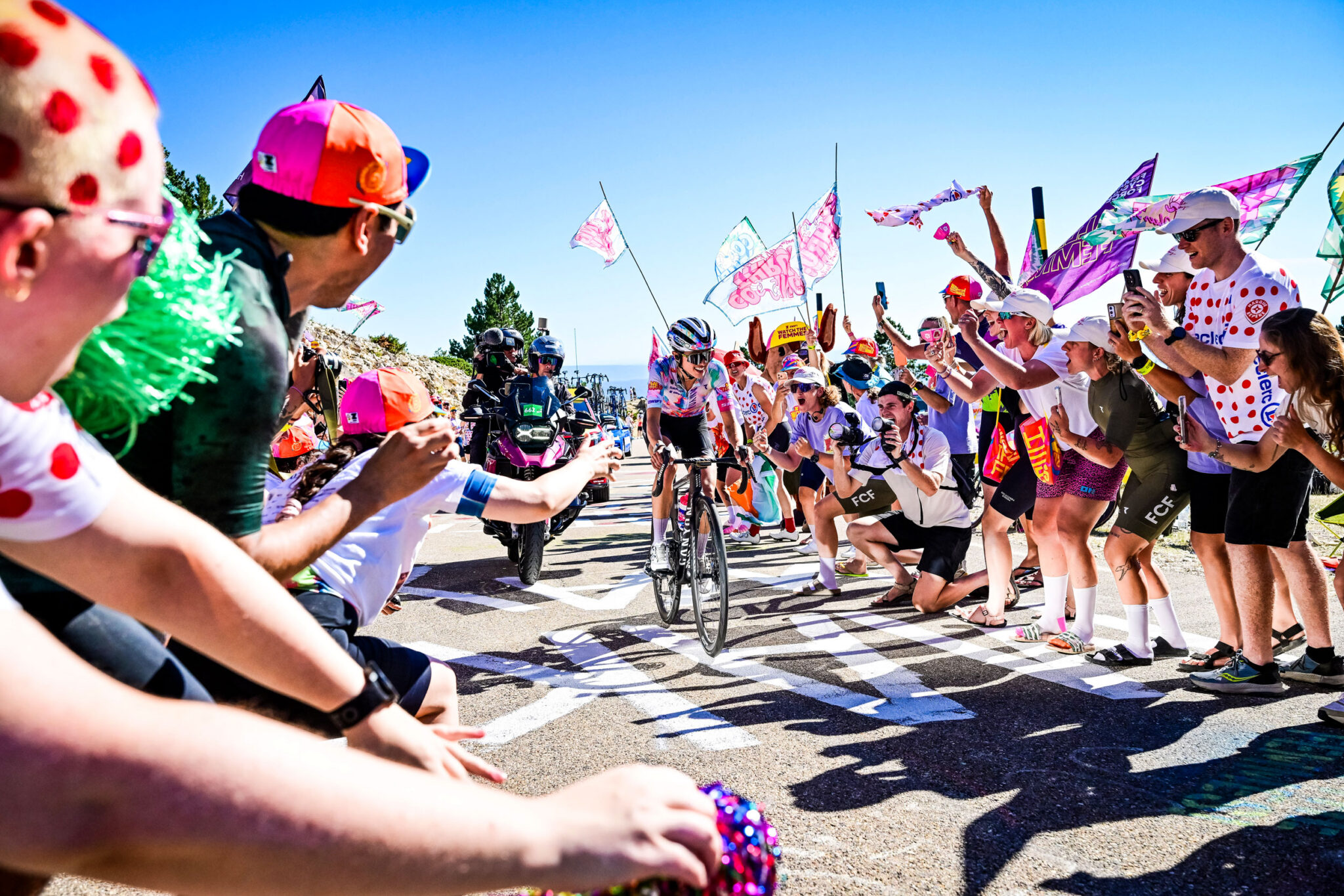
Creating community – Zwift’s Tour de France Femmes sponsorship
A few days before the start of the 2026 Tour de France Femmes avec Zwift Ride Media caught up with the title sponsor’s Director of Women’s Strategy, Kate Veronneau, to get some insight into Zwift’s investment in an event that has come of age in just five years.
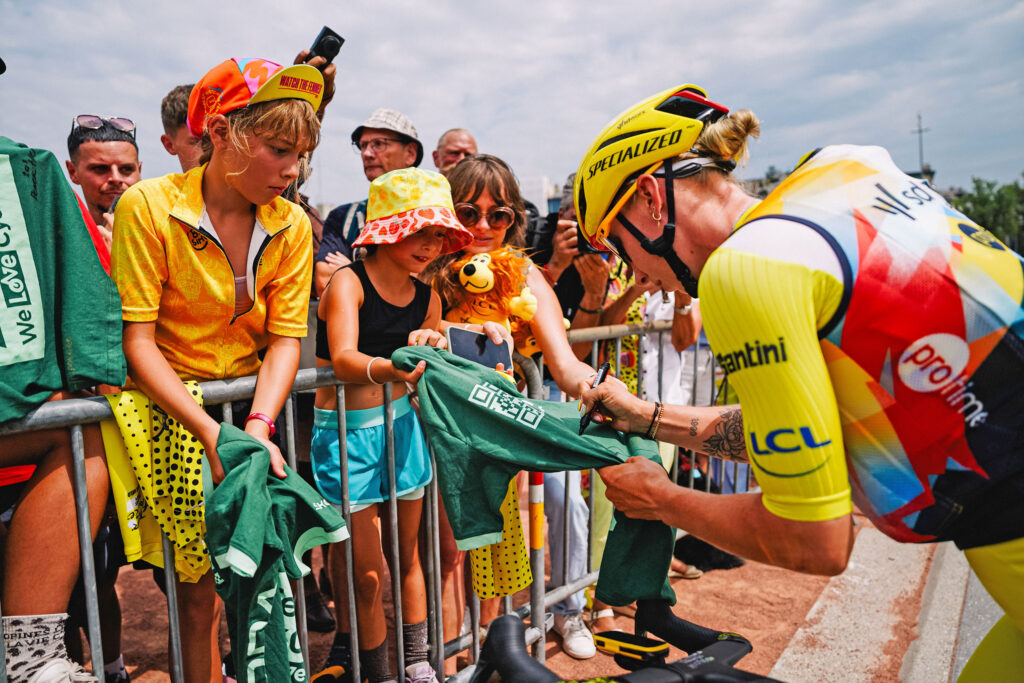
Photography by Billy Ceusters (via ASO)
“When we kicked off the race sponsorship [in 2022], 18 percent of new accounts were women on Zwift. That’s up to 23 to 24 percent, and I think it even might be higher than that now,” says Kate Veronneau about the virtual training platform that, she believes, is as much about building community as it is about improving fitness.
“That’s huge growth when you consider how hard it’s been to get women into this sport. And that’s why we really want to share that and shout it from the rooftops, so other people recognize it as a true growth opportunity.”
Supporting women’s cycling, Veronneau says, is “not just the right thing to do; it’s really good business”.
Until the relaunch in 2022 coverage of women’s racing was relatively scant. Live broadcasts were few and far between, largely only happening on occasions such the world championships or on regional channels for some of the bigger races. But, as those in the cycling realm often say, ‘the Tour is the Tour’ – ie. it’s an exceptional event that lures in spectators, media coverage, and sponsors alike in a way no other bike race – men’s or women’s – is able to achieve.
For Zwift the reward for “a significant investment” is not just exposure. There is also a tangible financial return, with more people signing on as members, as well as the feel-good element of growing the sense of community in the cycling space.
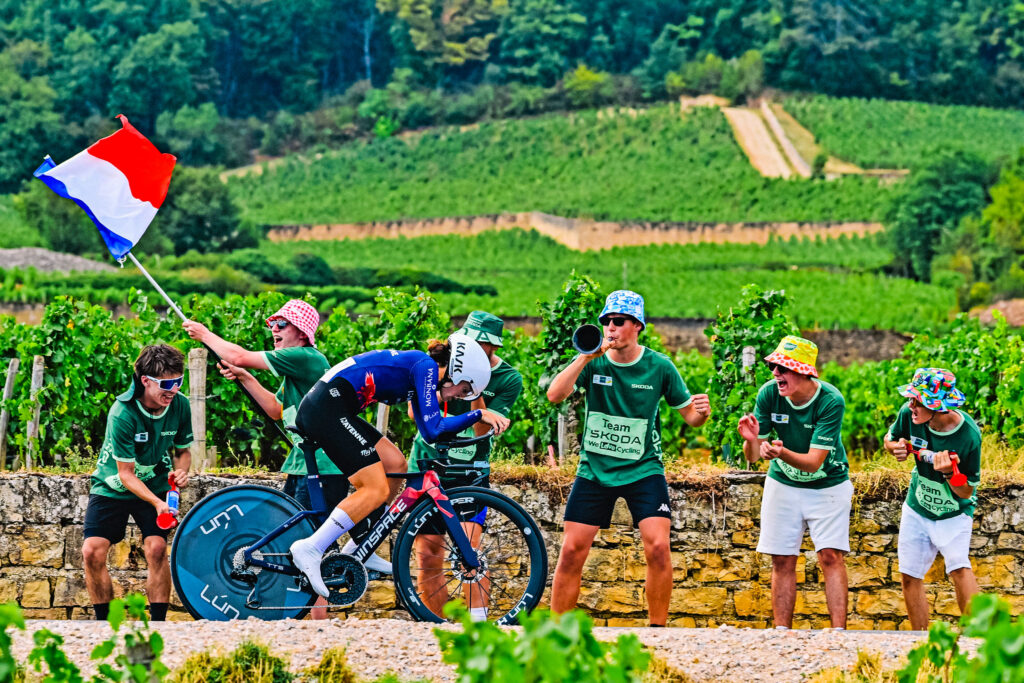
There have been Tours de France for women before but the latest iteration, officially titled the ‘Tour de France Femmes avec Zwift’ since 2022, has elevated the status of women’s cycling more than ever. It was a leap of faith by the Amaury Sports Organisation (ASO) that was long overdue, one that closed a gaping hole that had long existed in professional cycling, where men’s racing has traditionally dominated the narrative.
It’s early days but it’s fair to say that Zwift’s sponsorship, and ASO’s commitment to the growth of women’s sport, is levelling out the gender balance – certainly when it comes to elite competition. That, of course, is good for cycling as it provides inspiration and motivation for female riders who haven’t traditionally enjoyed the same level of opportunity that aspiring male cyclists have had.
Veronneau relishes the impact of the Tour de France Femmes sponsorship, not just because it contributes to growth in Zwift membership, but also because it has helped grow interest in women’s racing.
“It is great fun,” she says of the Zwift platform which gives riders a chance to train on a smart bike in a virtual setting with other riders and loads of data to highlight the effort that’s put in on the bike. “You find a lot of different motivations, and you need them at different times, you know? Sometimes you need something else behind you.”
* * * * *
Most people who come to Ride Media understand the concept of Zwift but, in part one of my interview, I asked Kate how she explains the platform to newbies.
“For people outside of cycling, when they say, ‘What do you do? Who do you work for?’, I say, ‘Zwift is a video game for cyclists where your power – your actual real-life effort – powers your avatar in a virtual world. But you can ride in real time with riders around the world… you can use it for training, for social rides, for fitness, for training for your next event.
“It’s a [training] platform that you can use… but it’s also a community.”
‘Zwifting’, Veronneau says proudly, has become part of the cycling vernacular. “It’s a brand that’s really pushing cycling forward – and it’s a verb, too..! I love it.
“When you say you ‘Zwift’… most cyclists know what you’re talking about, so that’s a cool status.”
The company was established in 2014 by Jon Mayfield, Eric Min, Scott Barger, and Alarik Myrin and it has evolved significantly ever since. In 2026 there are approximately 1.2 million users of the Zwift platform. For some it’s a ‘video game’, others consider it more of a training tool, but it has also helped build a sense of community even if participants are usually riding on their own but as part of a virtual peloton that’s arguably the largest cycling bunch in the world.
“I think something that we really brought to the market in a way that we haven’t seen in this sport before,” she explains about the sponsorship which essentially grew out of other activations Zwift has been involved with. “To really have that community aspect… that social aspect – that’s how we also got really into figuring out how we could grow women’s cycling.”
This is key reason for the sponsorship of the Tour de France. Women’s cycling is prospering – in the racing realm, certainly, but also in social settings on roads around the world. A big crowd of riders has emerged thanks to platforms such as Zwift, as well as other virtual cycling programs like Rouvy (now owned by Zwift), Fulgaz, and MyWhoosh.
“There’s been training platforms,” Veronneau says in part two of our interview on YouTube, “but because of that first Zwift Academy we did – that was only for women – back in 2016. [It] was the global try-out for a pro contract with Canyon-SRAM.
“When we did that program, we had 1,100 women around the globe join Zwift Academy to try and win the pro contract. But what we recognized towards the end of it was most of the women did not care at all about the contract… they just wanted to do a cool training program with a bunch of other women around the world.
“So that program, while it was so ground-breaking – ‘Wow, we’re going to have a pro try-out on Zwift, a virtual try-out, it’s so cool…’ – what we actually did was build the world’s largest women’s cycling community at the time. And that’s only grown, and that’s what really kicked off our efforts to see what else we could do to invite women into the sport, and to create events and space and community to motivate women in ways that they really haven’t been before.
“It’s a tough sport for women, and we have a cool space for them to kick it off and kind of find their community, and comfort, and confidence before they maybe venture out and do their first big group ride or event.”