
Retro: Liz Hepple, the first Australian on Tour de France GC podium (3rd in 1988)
In the 1988 the men’s Tour de France was a three-week race with a prologue and 22 stages. During the final fortnight of that 75th edition, there was also a 12-stage women’s race – the Tour de France Féminin… and an Australian cycling pioneer, Liz Hepple, finished third on GC. Gina Ricardo spoke to Hepple […]
In the 1988 the men’s Tour de France was a three-week race with a prologue and 22 stages. During the final fortnight of that 75th edition, there was also a 12-stage women’s race – the Tour de France Féminin… and an Australian cycling pioneer, Liz Hepple, finished third on GC.
Gina Ricardo spoke to Hepple and others to find out more about a time when women’s cycling was enjoying a growth spurt and laying the foundations for greater gender equality in our sport.

This feature was originally published in the Official Tour de France Guide (Australian edition) in June 2024.
– Story by Gina Ricardo
Looking back. Going foward!
Pioneering Australian riders Setting the tone for things to come
“You’d be riding towards a big mass of people up the climbs. The crowds and the fans would separate as you got there like you see it on TV. I’d have a motorbike 20 metres in front of me who’d move the crowd apart. We were all in our national jerseys… Everyone in the audience had someone to support. It was an experience you wouldn’t get now. We thought it was phenomenal!”
July 1988. Liz Hepple, after three weeks of racing, is third on GC. It’s the women’s Tour de France. The last day of the 12-stage race run concurrently with the men’s TDF (10-24 July, 839km from Strasbourg to Paris) and the women’s peloton rides into a hectic finish on the Champs-Elysées. The crowds are 10 deep, the cheering transforms the city into a stadium. The fatigue and the pain in the legs are forgotten in the rush of adrenaline on those final stretches, knowing that the team is about to pull off what has never been done before – a podium finish for an Australian rider at the Tour de France.
In an instant, it’s almost all over! Liz punctures.
The Australian team rallies around her. There are no race radios, she must rely on her team-mates and the team car to just realise she needs a spare wheel. “We hadn’t punctured much in the race and we hadn’t had a lot of practice, so it was good that it did work out!” She laughs when she describes the moment of the wheel change. They get back on to the bunch and cross the finish line. Liz finishes third, an incredible achievement.
Liz Hepple set an Australian sporting precedent… and virtually no one knows about it.

In today’s new age of the Tour de France Femmes avec Zwift not many remember that the first women’s Tour de France, run by the ASO, was originally held in 1984. The women used to start their stages halfway along the men’s stages on the same day, riding the same course as the men, finishing around two hours ahead and, at the end, sharing the podium in Paris.
Liz Hepple and her team-mate Donna Rae-Szalinski were part of the Australian national team who were sent to France for those first three races Australia participated in: 1986, 1987 and 1988. It was, as Rae-Szalinski describes, “a fucking unbelievable experience”.
The other Australian starters from those years included: Robyn Battison, Debbie De Jongh, Kath Shannon (1986); Donna Gould, Jacqui Uttien (1987); Marisa Gori and Kathy Watt (1988). In the first year Australia had five riders (rather than the maximum seven), then six and, by the time Hepple was contesting the podium, the full contingent.
These sporting pioneers were part of the original cohort of women who paved the way for future generations of professional female cyclists in Australia.
You don’t have to look back very far to understand the history of women’s cycling in Australia but when this wave of athletes raced in Europe there was still a clear distinction between professional and amateur sport. Participation in the Tour de France, however, blurred the lines. Remember, it wasn’t until the 1996 Atlanta Olympics that professionals were (officially) allowed to compete in the Games.
From amateur to professional
The real evolution of women’s cycling in these formative years started with the introduction of a women’s road race for the 1984 Olympics in Los Angeles. (Connie Carpenter won gold for the USA with compatriot Rebecca Twigg taking silver, and Sandra Schumacher of West Germany the bronze.) Australia didn’t send a team to compete in LA but in 1985, prompted by the inclusion of a women’s race, the national federation sent over four women to race the world championships held in Giavera del Montello, Italy.
This cohort didn’t continue in the sport but, in 1986, a national team lined up for the Tour de France Feminin and other races that later included the Giro d’Italia Femminile (which was first held in 1988 as an eight-stage race in June).
In 1988 Liz finished second on GC in the Giro d’Italia (won by Maria Canins) and third in the Tour de France (behind Jeannie Longo and Canins). Kathleen Shannon was in the top-10 of Australia’s debut in the women’s Olympic road race in Seoul 1988. And the new focus on women’s cycling by the Australian team culminated with Kathy Watt winning the road race gold medal of the Barcelona Olympics in 1992. Longo won silver, later insisting she didn’t know Watt was up the road. Shannon again finished in the top 10.
The success of this era continued into the next generation, but only after a considerable push to grow women’s cycling came about because of Watt’s success in Barcelona. The Games in Athens in 2004 was the best Olympics ever for an Australian team that collected six gold medals in total, five on the track and one in the women’s road race, won by Sara Carrigan. The win was decided in a two-up sprint from a breakaway: Carrigan versus Judith Arndt, a German with strong links to Australia during and after her racing career.
In the intervening years there was a concerted effort to push the agenda for women’s cycling but it wasn’t always easy. A road cycling program was created by the AIS and was guided by former East German coach Heiko Salzwedel. The catalyst was Watt’s gold medal ride in 1992 and Olympic success remained the focus.

Salzwedel insisted that, for Australian riders to compete against the strongest teams, they needed more competition and – with the Sydney Games in 2000 fast approaching – he set about growing the road cycling program during the time when pro and amateur sports morphed into what we know it as today. Within a few years the AIS had teamed up with Giant Bicycles and other corporate sponsors including, of course, Jayco Caravans which backed Watt in the lead-up to the 1992 Olympics. The foundations of a professional road cycling team that included both men and women were created. Some of those involved in those early years continue to have strong links in this new era, and the contributions of Jayco and Giant remain strong in 2024.
Australia: 2nd in the world rankings
Former coach of the women’s sprint program on the track, Martin Barras, who guided Anna Meares to her first gold medal at the Olympics (the 500m TT in Athens 2004) was later appointed to lead the women’s road cycling program (from 2009 to 2017). He calls that time the “Golden Era of Australian women’s cycling”.
“Under coach James Victor women’s cycling in Australia went from the middle of the pack contender to being ranked second in the world rankings. It’s the highest ranking the national team ever held. Carrigan’s gold medal is one major result of the times.” It was indeed a golden era of Australian cycling and while Dutch domination was a feature of the times, with Leontien van Moorsel-Zijlaard winning three gold medals at the Sydney Olympics (individual pursuit on the track, plus road race and time trial) Anna Wilson was the stand-out Australian performer on the road, finishing fourth in the road race and TT in Sydney 2000 and winning the World Cup crown in 1999 and 2001.
The boost in funding, from the government-backed AIS as well as Jayco – thanks to the contributions of Australian cycling’s biggest benefactor, Gerry Ryan – helped grow the talent pool but it was more than that. “Everybody was just putting their shoulder to the wheel,” says Barras of the time. “There was a common goal with Sydney 2000.”
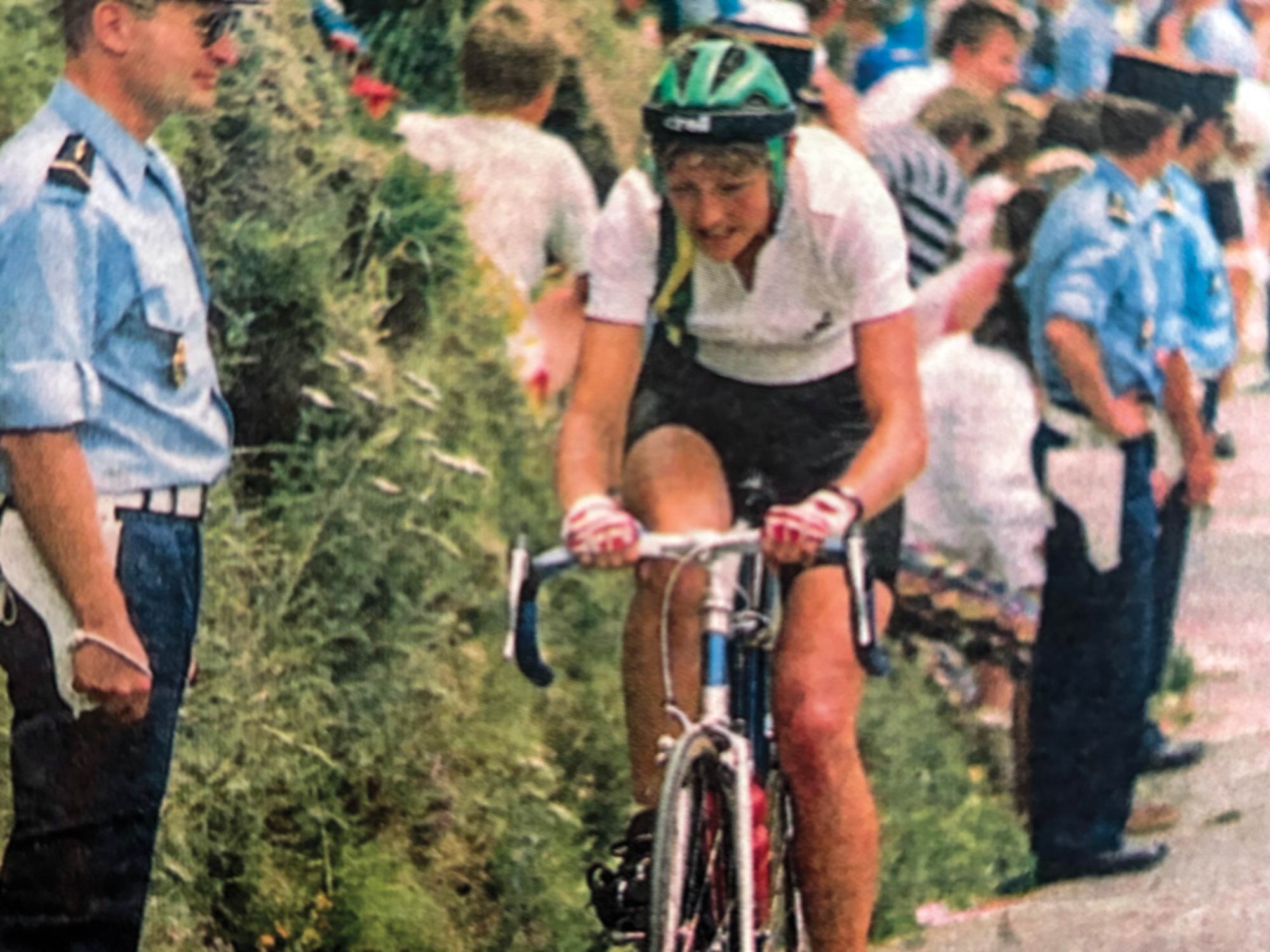
Riders like Donna Rae-Szalinski and Liz Hepple didn’t have many races at an international level to help them gain experience. In Australia there were few women-only races but they paved the way for change. The rare times they raced only against women were at state and national titles. “Most of the time I just raced with the men in the opens like the Melbourne to Ballarat,” said Rae-Szalinkski. “I can remember lining up for a track race with Kathy Watt and the commentator saying, ‘Oh the girls are lining up for the start of their scratch race, pretty sure they’ll be swapping recipes’. Sometimes I got a prize – but you’d probably get something like men’s aftershave. It’s come a long way.”
Rae-Szalinkski was familiar with wearing lycra before she jumped on the bike. She explains how it was that she got into a marginalised female sport. “I was a runner. I ran the Gold Coast Marathon twice. I was teaching aerobics classes to help pay the bills. It’s not smart to run a marathon and, in the next 48 hours, teach high-ballistic aerobics classes… I ended up with stress fractures in my feet! I couldn’t run. I swim like a rock. So, I started riding a bike… that’s how it began. Liz Hepple was my bestie, we both lived in Brisbane and started riding together. We rode our first nationals in 1985, got picked in the national team and got sent overseas the next year – to ride our first Tour de France in 1986.”
Hepple came into the sport through a more conventional pathway, originally from triathlon. To go from the national championships in Australia straight into the Tour de France was a big leap, but she thrived in the mountains. “In 1986 I placed fifth. That was a bit of a shock because if it had been a flat race, I would’ve been mid-pack. I knew I could climb but I only found out I was good at climbing day after day at the Tour de France.”
There wasn’t much funding for the team in 1988, but for riders like Donna and Liz, it was about the experience. Compared to the set-up of teams today, where staff often outnumber the riders, they had barely any support.
“We had to pay for our flights and equipment. We had some accommodation covered but we covered most of the costs,” says Rae-Szalinski. “I was given two jerseys to race the Tour de France in. We also got a track suit. The next year we didn’t have to pay for accommodation or flights. And by 1988 we were on the AIS program. We never got paid a salary and for those three Tours de France we never got supplied equipment. It was a challenge for the mechanics having to service six completely different bikes but we were just happy to be there. We didn’t know any different.”
When asked how much Liz won for her third place in 1988, the answer was “I won 500 francs (±AUD$125) and that was split amongst the team of seven riders.”
Lessons from the past
Liz Hepple’s tip for racing the Tour de France: “It’s decided in the mountains. I was never much of a time trialler, so I’d drop a few places back in GC after a time trial but be able to climb my way up again in the mountains.”
When asked if Hepple’s third place in the Tour de France of 1988 increased interest in women’s cycling in Australia, Rae-Szalinski laughs and shakes her head. “No, not really. What she did that year – third in the Tour, second in the Giro – imagine if a man had done it. I don’t think she has received the accolades she deserves for her performances.”
Rae-Szalinski recalls how, in 1986, Phil Anderson was a great supporter of the women’s team. “At the finish of our first Tour they had a banquet for both the men and women riders. Phil was racing the Tour at the time and during the race he would come and give us advice – what gears to use, things like that. He came and sat with us at the end of the Tour and we had a great chat. The culture of the event back then was phenomenal.”
Since those days the rise to prominence of Dutch and Belgian women cyclists has been significant. Hepple notes the change since her time at the Tour. “When we were racing, the Dutch and Belgians were mainly sprinters – big, strong, powerful, quick women. They’d always dominate the flat stages and were very good bike handlers. But none of them could climb! They obviously figured that out.”

In 2024 the Tour de France Femmes avec Zwift is more than just a bike race. For years the men’s Tour has been the pinnacle of the sport: winning the yellow jersey is seen as a greater achievement than winning an Olympic gold medal. To have a women’s version, complete with live television coverage and appropriate prize money, highlights the huge changes that have come with the revised event.
“It’s awesome. Women’s sport in general – all around the world – has reached that critical mass where it’s going to get better and better,” says Hepple in 2024. “Maybe I’m being overly optimistic, but I feel like people aren’t questioning whether to support women’s sport anymore. It’s the right thing to do because there’s always the argument that the women aren’t as fast or as powerful as the men, that they don’t get the same media sponsorship… they’re just excuses.
“If I’d seen women racing or playing football on TV when I was a little girl, it would have changed my perspective of what I could do and what I could achieve. That’s what was missing. We didn’t know sport was for us. Having women’s sport televised means that cycling is for everyone. It opens up possibilities, the dreams and the goals for young women. It’s not the same as the men’s but hopefully it will keep continuing to grow. It’s a hell of a lot better than what it used to be! That perception of your self-esteem and how you define yourself as female can completely change by having role models like that, that you can see.”
Andrew Logan, who led the women’s road program during the Salzwedel years at the AIS in the afterglow of Kathy Watt’s win at the Barcelona Olympics, neatly sums things up. “Athletes, regardless of gender, deserve to be a professional. You’re choosing sport as your first career and deserve the opportunity to earn an income. It is work and you want to be rewarded for your time and commitment.
“It’s demanding. There’s a lot of effort and resilience is required. The motivation, the commitment, the desire, the travel… there’s a lot to consider when trying to perform well and contribute to outcomes. Not only that, but it’s also about what sport brings to the community and what it brings to the broader population: it provides entertainment. Athletes need to be rewarded for what they do.”
So, thank you to the ASO, to Zwift and other sponsors. Thank you also to the athletes, teams and staff, media and, of course, the fans who have helped make cycling what it is today. The evolution of our sport continues and we look forward to an entertaining race this August.
– By Gina Ricardo
Note: RIDE Media has published the Official Tour de France Guide (Australian edition) since 2003.