Bike test: Polygon Strattos C8 Di2
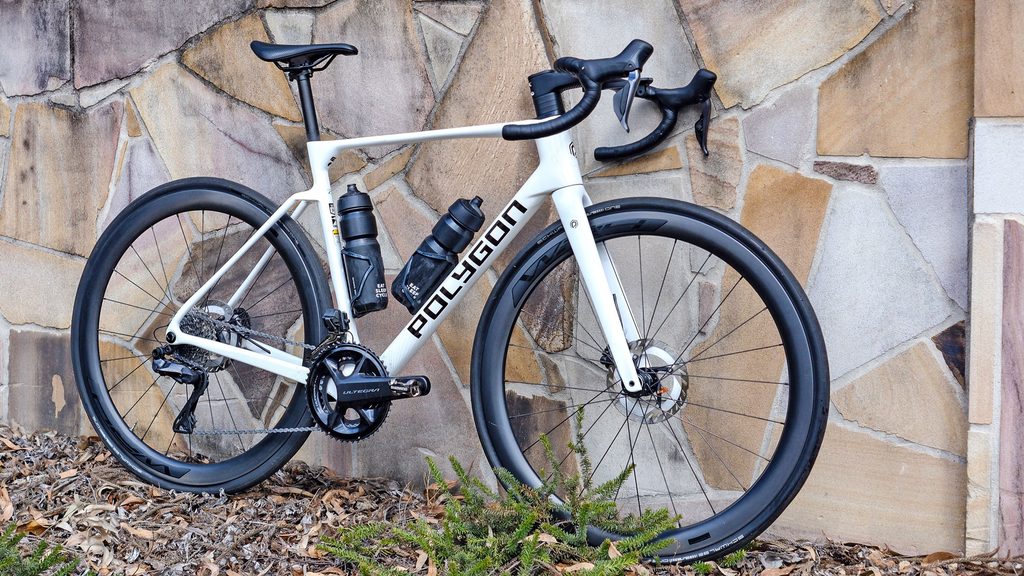
At AUD$4,999, the Polygon Strattos C8 combines the latest of Shimano’s Ultegra Di2 groupset, quality carbon wheels, and an integrated carbon cockpit with endurance-focused geometry.
Review by: Max Hobson
Key details
- Brand: Polygon (distributed in Australia by BikesOnline)
- Product: 2026 Polygon Strattos C8 Di2
- Product RRP: AUD$4,999*
- Weight: 8.1kg (without pedals)
- Test period: ±2,500km
- Test location(s): Australia, Germany, France, Switzerland and Spain, including a 2,000km-plus bike-packing trip from Frankfurt to Barcelona
Max took a Polygon Strattos to Europe, unboxed it… and then set off on a 2,000km adventure through four countries to see how this well-priced, neatly-spec’ed bike performed when it really mattered…
What makes a road bike good? Of course, this is subjective, and there are many variables, certainly when you consider the current state of the market. For some riders it needs to be lightweight, with aggressive handling traits that make it immediately responsive. Others may list comfort as a priority when making a purchasing decision. And, of course, there are riders looking for something in between: a bike that’s quick enough when the pace comes on but comfortable and predictable enough to spend an entire day riding.
Coming from a racing background, I’ve traditionally gravitated towards the former. My bike – well, my current road bike / race bike – is a Pinarello F7, so I’m accustomed to a lighter, sharper race bike than the Polygon featured here, although I have also spent plenty of time on endurance road bikes, and a wide range of gravel setups – from the ‘cyclocross’ days through to now when gravel has become a major player in the cycling market… and I’ve done my fair share of long rides that haven’t been races. And, as is the case with this review, bikepacking trips are also part of my repertoire.
When BikesOnline approached us about reviewing the Strattos C8, the timing was almost suspiciously good. Earlier in the year, long-time mate Liam Bertuzzi had floated the idea of riding from his hometown near Frankfurt, through through the French Alps to watch the Tour de France, then continuing a bikepacking journey all the way to Barcelona, only a short time after the Grand Départ of the TDF in Catalunya.
Being someone who rarely turns down a cycling side quest, I’d already replied “Yes!” even before Liam had finished explaining the itinerary and finer details of what would become a fantastic European summer-time adventure.
When BikesOnline mentioned they wanted someone from RIDE Media spend some time on the 2026 Strattos C8, I mentioned the trip Liam and our mates were going to do. Again: “Yes.” And so it would be that, a few weeks later, I was in Germany with a white bike in a box, and 2,500 kilometres of cycling ahead of me.
Oh yeah, another little detail: the bike, the Polygon Strassos C8 was new, still in the delivery box. It would be assembled by me for the first time upon arrival in Frankfurt. I’d never ridden it but the time would come…
Why Am I Reviewing This?
I’ve raced at an elite level and spent plenty of time on everything from aggressive road race bikes to endurance and gravel set-ups, so I have a reasonable idea of what I like and where compromises start to become noticeable. I’m also coming at the Strattos from a slightly different perspective to the customer who is most likely to buy it. My preference would normally be a purebred race bike but that’s not to say that the Strattos didn’t meet my needs…
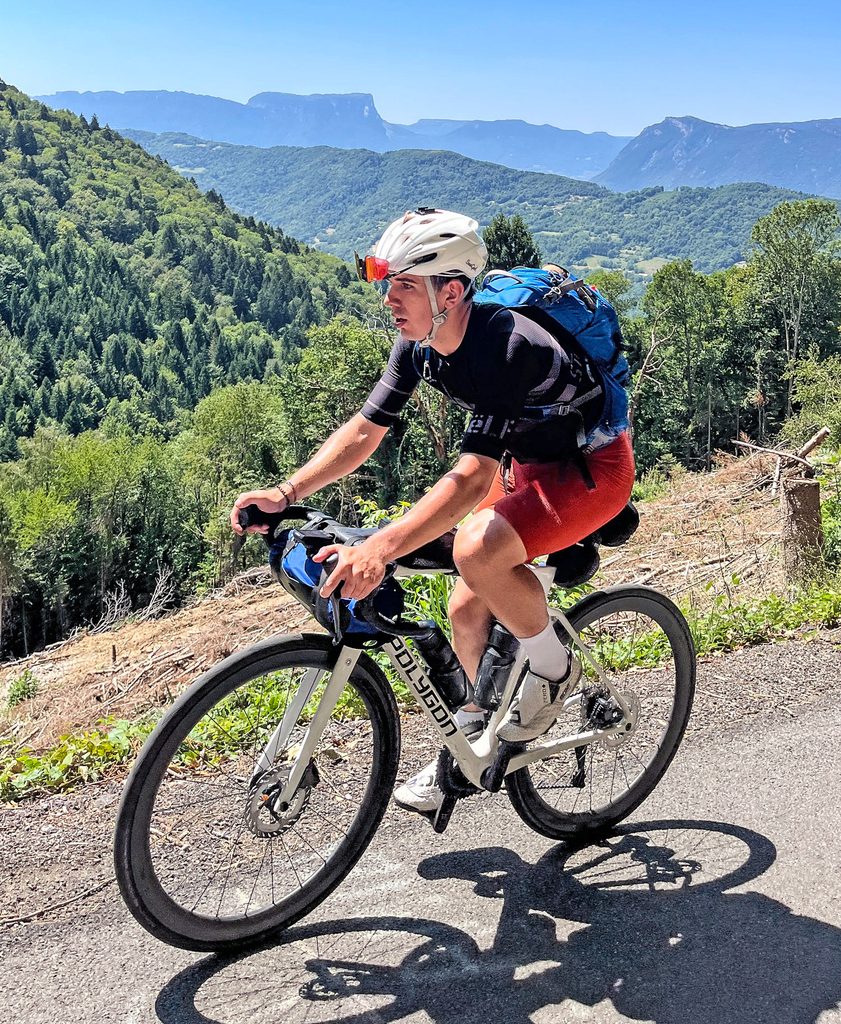
My trip to Europe provided exactly the kind of setting that highlights benefits of an ‘endurance’ bike like the Strattos is suitable for. For around 2,500 kilometres it allowed me to manage long days in the saddle while carrying plenty of bike-packing gear. It handled the myriad conditions of what became an epic ride in style… wet roads through Germany and France, high Alpine climbs and descents, fast and busy roads, quieter side routes, rough surfaces, and even the occasional small stretch of gravel.
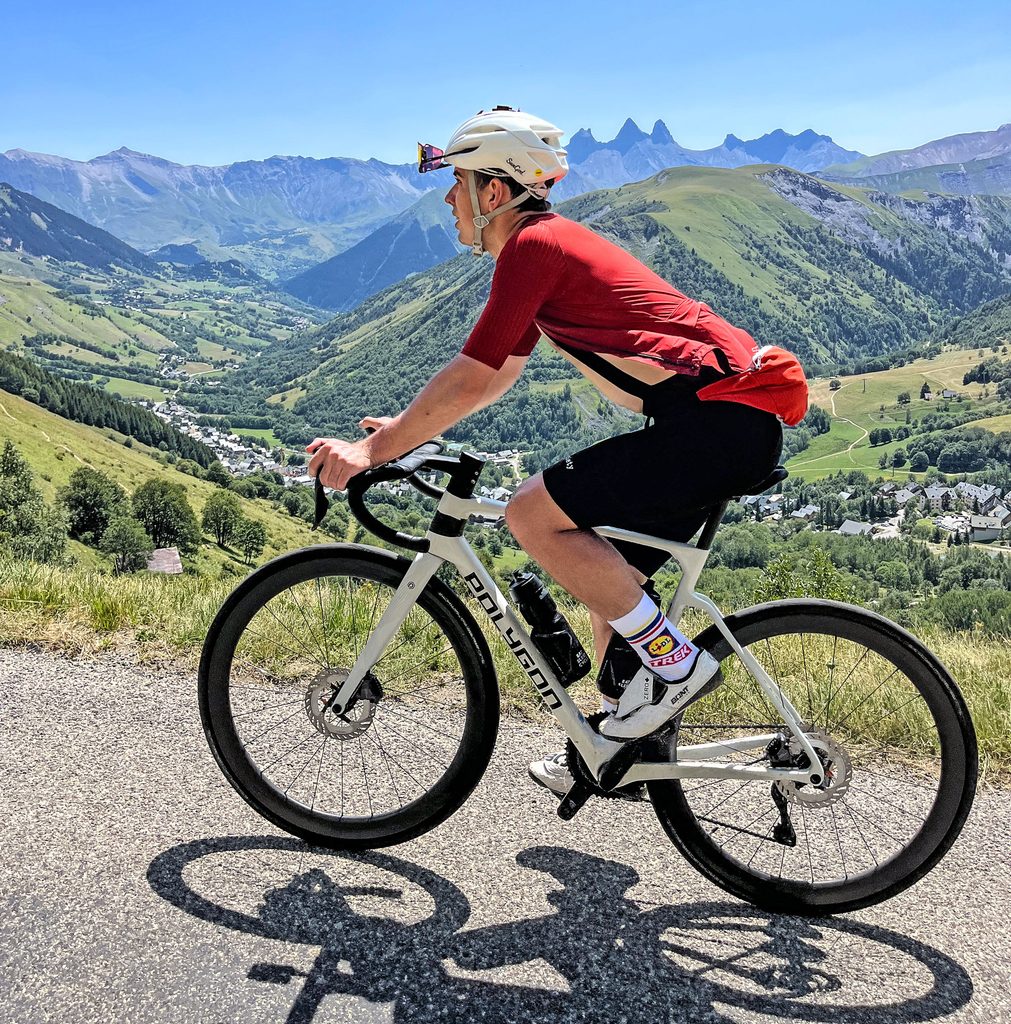
Along the way we stopped to watch the Tour de France from the roadside party on Alpe d’Huez before continuing onwards to Barcelona. By the end of the trip I had a good impression of how the Strattos behaved. I’m pleased to say: it was ideal for the kind of cycling we did… and even exceeded my expectations.
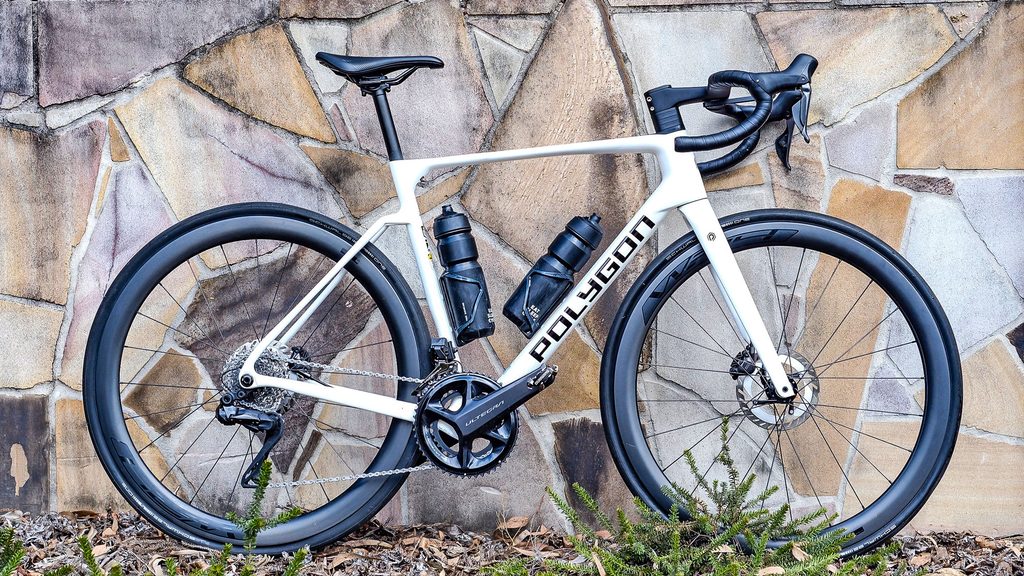
Quick Specifications of Polygon Strattos C8 Di2
- Frame & fork: ACX All-Round full carbon
- Claimed weight: 8.1kg without pedals
- Groupset: Shimano Ultegra Di2, 2×12-speed
- Crankset: Shimano Ultegra FC-R8100, 50/34T
- Cassette: Shimano Ultegra CS-R8101-12, 11-34T
- Rear derailleur: Shimano Ultegra Di2 RD-R8150
- Bottom bracket: Token T47 68
- Chain: KMC X12 EPT
- Cockpit: LINC carbon integrated bar/stem
- Wheels: Polygon WR4 Carbon Disc, 45mm
- Tyres: Schwalbe One Addix TLE 700x30C
- Brakes: Shimano Ultegra hydraulic disc
- Rotors: Shimano Ultegra CL800, 160mm front and rear
- Seatpost: Polygon Xpert alloy, 27.2mm
- Saddle: LINC GLYD
- RRP: $4,999
First Impressions
Travelling to another country and embarking on a 2,000km-plus trip on a bike you’ve never ridden is not something I’d normally recommend, but thankfully the Strattos made a good first impression.
After I arrived in Nidderau, Germany, assembly took less than an hour. After the easy unboxing, there was the obligatory fitting session to get my position dialled.
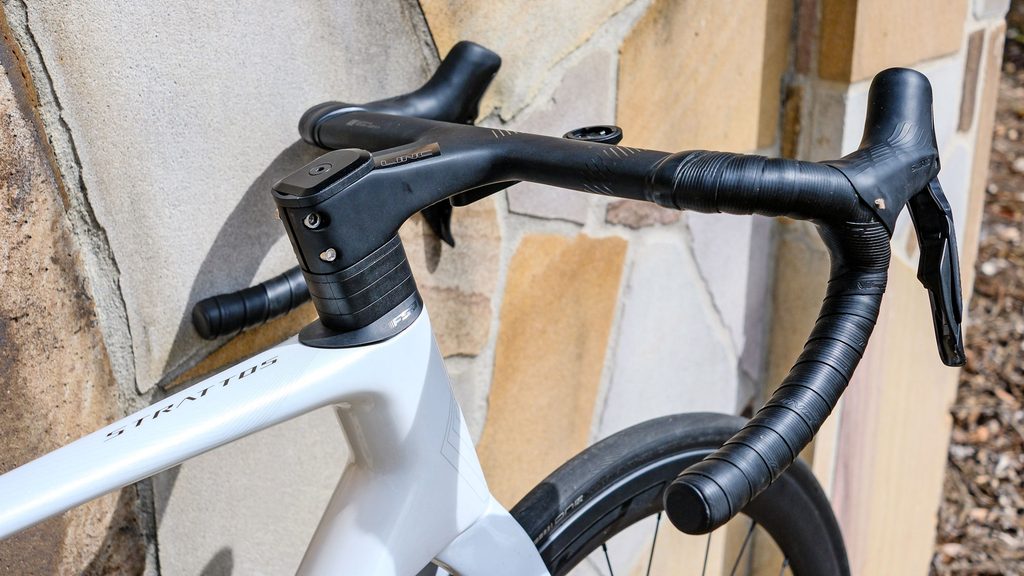
Inside the bike box were all the necessary tools and accessories required to easy assembly, including an analogue torque wrench, tubeless valves, frame protection stickers… and a handful of other useful extras. The only part that required a bit more patience during the build was the integrated cockpit. Getting the correct stack height was fiddly and, visually, the front doesn’t look its best until you’re confident enough in your position to cut the excess steerer. (On a review bike, there is sometimes a need for compromise…) Once I got it all sorted though, I loved the cockpit.
Four hours after landing, with jetlag and swollen legs doing their best to convince me not to ride, Liam and I headed out. Two things immediately stood out: the position and the way the bike carried its weight.
At a claimed 8.1kg without pedals, the Strattos isn’t especially heavy for what it is, but compared with my personal bike (a 2026 Pinarello F7) it doesn’t have the same immediate response when you jump on the pedals. Instead, it feels more planted and substantial underneath you. Initially that seemed like something that would frustrate me a little, but this ride was different to what I’m normally doing when I’m at home in Brisbane. During the few weeks on the roads of Europe, however, I came to realise how the same planted character was responsible for some of the bike’s biggest strengths.
Performance
On the road
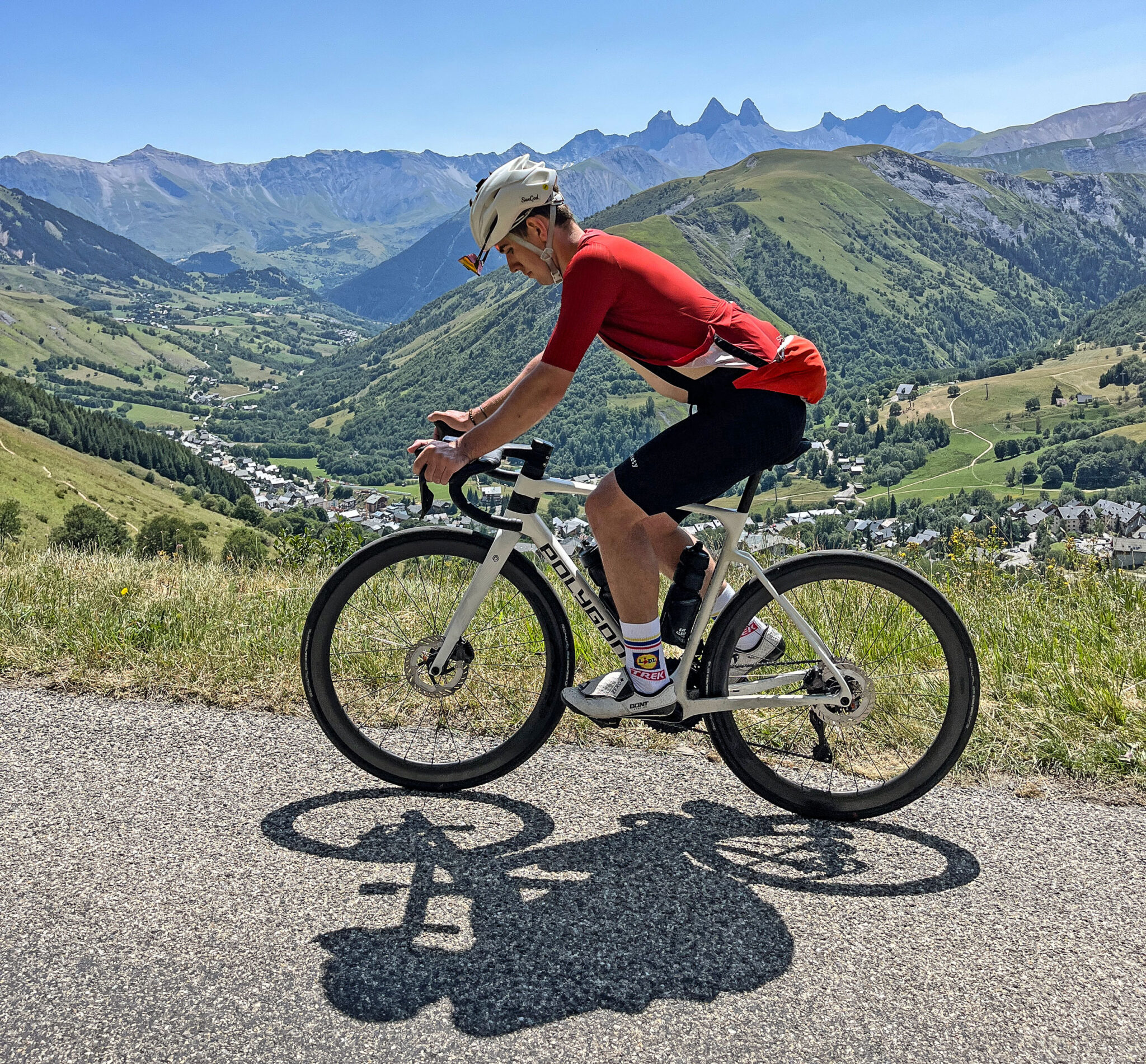
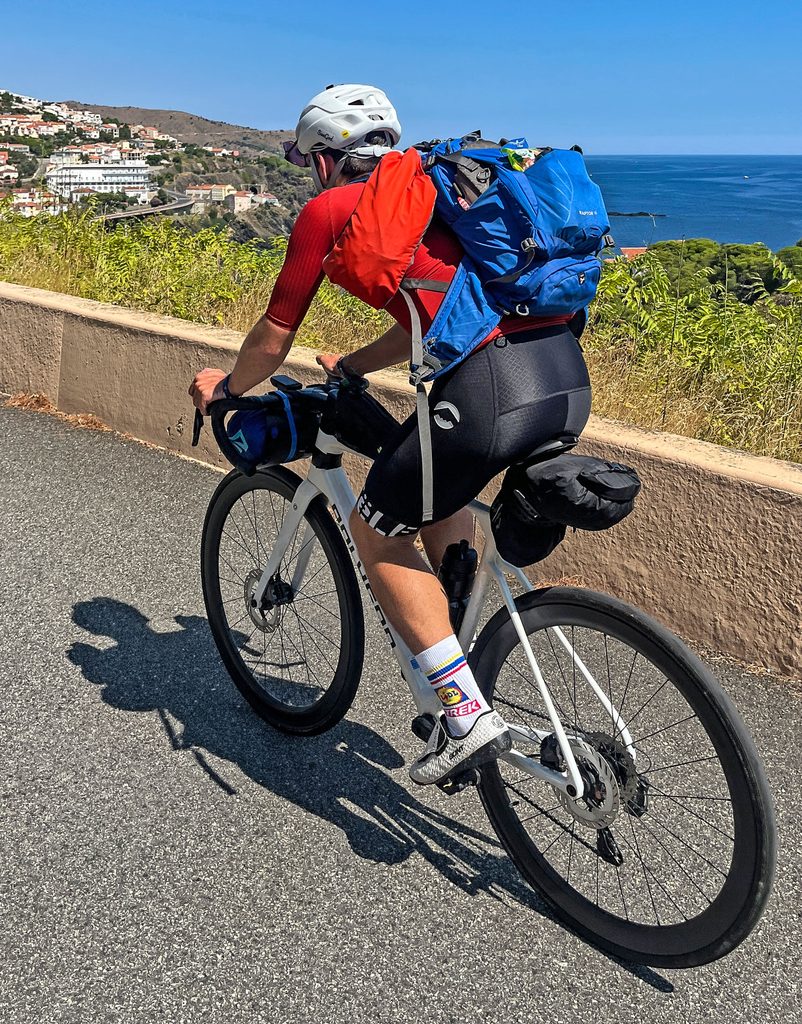
If I had to sum up the Strattos after 2,500km in one word, it would probably be: predictable. That doesn’t sound particularly exciting, but on unfamiliar mountain roads with luggage strapped to the bike, predictability becomes a very attractive quality. The Strattos never felt nervous or twitchy. It went where I expected it to go, remained composed and surprisingly stable when the surface deteriorated, and dealt well with the extra weight of my bike-packing set-up: a tightly-packed bar bag holding a dry bag, another dry bag strapped behind the saddle and a backpack.
Packing and weight distribution obviously play a major role in how a loaded bike handles, but once everything was sorted the Strattos never felt like the limiting factor.
At slower speeds and through tight corners, the handling didn’t stand out as either exceptional or poor.
As the speed increased, though, the handling traits of the Strattos became considerably more impressive. It holds momentum well on flat and rolling terrain and never felt overly restrictive once up to speed. The more relaxed riding position also brought an unexpected advantage. While it isn’t as aggressive as the set-up I’m accustomed to, I could hold a decent aerodynamic position for longer than I expected and I think that’s largely because I wasn’t constantly fighting discomfort or trying to nestle into the right position. For an endurance bike, this is something that’s useful.
Descending
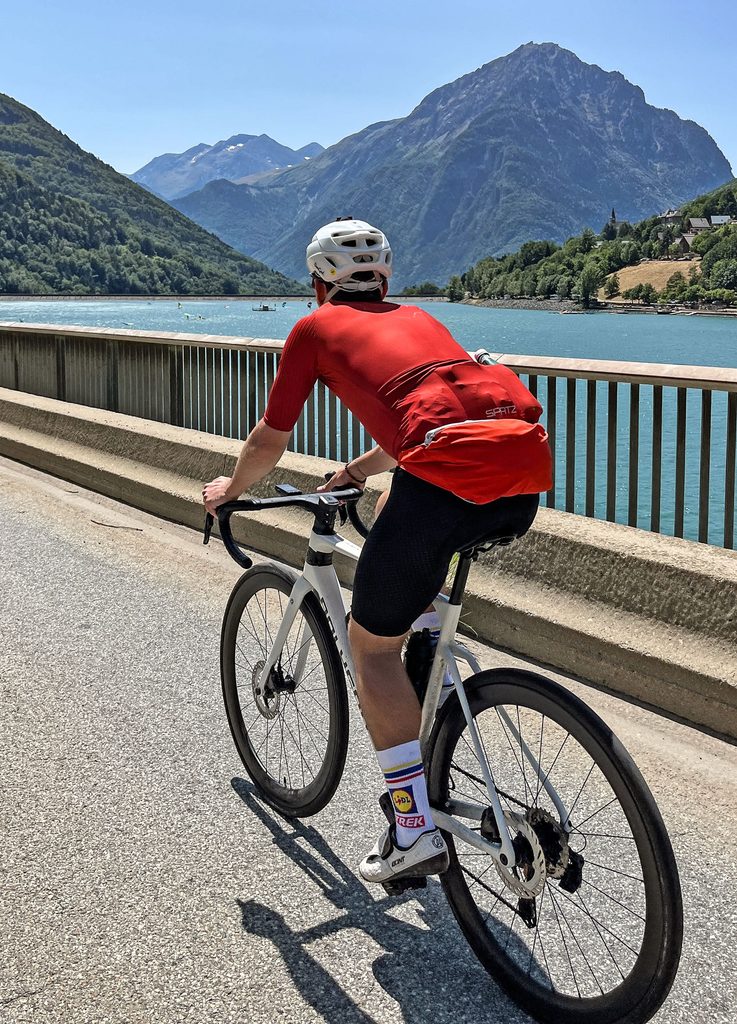
It was on fast descents that the Strattos really performed beyond expectations. We rode numerous long Alpine roads – up and then down… again and again – many of them were tackled when the bike was fully loaded, and it was consistently planted and predictable.
A standout moment was the descent of Alpe d’Huez. At high speed, the Strattos sings! The grip of the 30mm Schwalbe One tyres gave me the confidence to commit to leaning into corners without concern, wondering if the bike would hold on to the wild ride. With luggage attached and plenty of kilometres already in the legs, I could simply let it roll.
Mont Ventoux provided a few more challenges as the weather became ridiculous. As is often the case in this part of France an extremely strong wind was blowing – with gusts reported to be up to 100km/h. In such a setting no bike is going to make the journey easy. It was pushed here, there, and everywhere when the Mistral blew with ferocity! I wasn’t alone in my suffering. Liam also wrestled his bike as we took on the Giant of Provence. In normal conditions, I had no notable problems with crosswinds.
Climbing and acceleration
The Strattos climbs perfectly well but it isn’t an all-out climbing bike. Coming off my Pinarello, that’s one of the areas where the difference is most obvious. A lighter race bike gives you an immediate surge when you get out of the saddle and accelerate out of a hairpin, or roll off from a set of lights, or sprint for a town sign. The Strattos doesn’t have quite that response, and I suspect the WR4 wheels play a meaningful role. They keep the cost relatively low but they are also heavy and stiff, and the extra rotating weight (compared to what I’m used to) is noticeable.
That said, we climbed enough mountains to establish that the Strattos will happily go uphill all day. The 50/34T crankset paired with an 11-34T cassette was excellent for loaded Alpine riding, and I never found myself short of climbing gears. At the opposite end, there were some long, straight downhill sections where I could spin the gearing out, but that’s hardly unusual for a compact endurance set-up.
Acceleration might not be one of the bike’s defining strengths, but it still has decent sprint ability once you’ve wound it up. For all my criticism about it not accelerating like a race bike, I still managed to claim a few town-sign sprints around Girona against some local legends, so it can pack a punch when required.
Shimano Ultegra Di2 and braking
In my opinion Shimano Ultegra Di2 is still one of the best road groupsets and nothing about this trip changed my view. Shifting is excellent and the hydraulic disc brakes dealt with repeated Alpine descents without any drama – often when the bike was loaded. The brake pads were, I should add, absolutely ready for replacement once I was back home in Australia but considering what they went through it’s not surprising. (Note to self: if I ever do a ride like this again, perhaps pack a spare set of brake pads…)
Oh yeah, I did manage to empty the Di2 battery at one point of the trip. My error… and just another thing to consider when you go bike-packing. Remember: pack the charge cable if you’re going on a long trip. I charged it overnight and carried on.
Design and purpose…
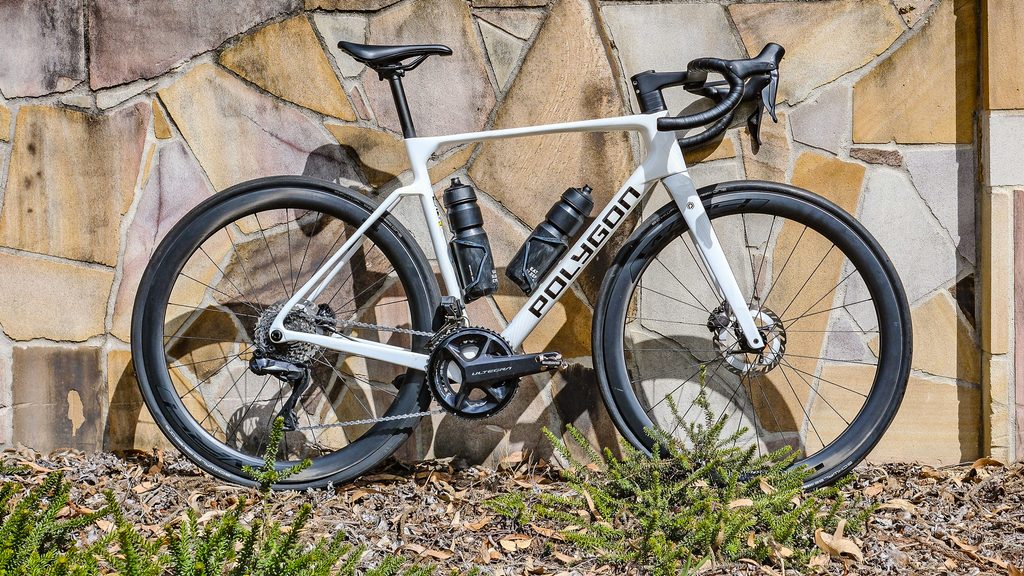
The Strattos is a good-looking bike. The white frame works particularly well with the black wheels and cockpit, and once the front end is set low and the excess steerer has been dealt with, the whole package looks considerably more expensive than its $4,999 price would suggest.
The LINC integrated carbon cockpit was one of my favourite parts of the bike. Once set up, I loved both the feel and the clean appearance.
The WR4 carbon wheels are the one element of the bike that I have mixed feelings about. They’re 45mm deep, tubeless-ready and clearly robust, but they feel heavy and stiff compared with a more performance oriented wheelset. My first upgrade if this were my bike would be new wheels.
Still, this is a sub-$5,000 bike that comes stock with carbon wheels. Given that the wheels survived a 2,000km-plus loaded trip without a single issue, Polygon’s decision to prioritise strength and value rather than chasing the lowest possible wheel weight makes plenty of sense.
It is, however, worth noting that all bikes in the Polygon Strattos carbon-fibre range use the same frame, only the components vary to alter the pricing structure. (While on that topic, it’s worth highlighting that Bikes Online often have some pretty good deals… with considerable savings on offer.)
Comfort / Practicality
Comfort was one of the biggest standouts of the entire test. We spent some very long days in the saddle, often carrying bike-packing gear, and I was surprised by how little soreness I experienced through my back, neck and hands.
The more relaxed geometry takes pressure off the body without making the Strattos feel slow or overly upright, while the 30mm tyres helped take some sting out of rougher roads. The stock tyres themselves were largely uneventful, which is exactly what I want from tyres. I ran them with tubes because I’m ‘Old School’… and on this adventure I suffered only one puncture.
The stock LINC GLYD saddle was slightly complicated. I developed some fairly unpleasant saddle sores early in the trip – but this was the result of a combination of elements including a saddle shape that was noteably different to my set-up, as well as long days on the bike… I had, after all, gone from my ‘normal’ riding routine to huge consecutive days on a completely unfamiliar saddle.
The saddle sore issue quelled as the trip progressed. By the latter stages I was comfortable enough that it stopped being something I thought about. Fit is equally personal.
At 178cm I rode a medium and found it perhaps fractionally larger than my ideal, although I tend to size down and favour a compact race bike fit. For most riders I suspect the sizing would feel entirely normal.
Perhaps most importantly for an endurance bike, durability was excellent. We rode through wet weather in Germany and France, damp conditions around Alpe d’Huez, long Alpine days, rougher roads and a little gravel. The bike simply kept going, and by the end of the trip I never felt like reliability was something I needed to think about.
Value For Money
At $4,999, the Strattos C8 represents extremely strong value. Shimano Ultegra Di2, hydraulic Ultegra brakes, a carbon integrated cockpit and 45mm carbon wheels is a serious specification at this price, and importantly, the bike didn’t just look good on a spreadsheet.
There are lighter bikes and there are bikes with more immediate acceleration, but you’re generally going to pay considerably more for them. The Strattos instead puts the money into components riders want and builds them around a versatile endurance platform. If I were judging it on specification alone I’d call it good value. Having ridden it across Europe, I’d call it very good value.
Final Thoughts
Would I personally buy the Strattos C8 as my main road bike? Probably not, but that has more to do with me than the bike. I race and naturally gravitate towards lighter, more aggressive race bikes. If my priorities were endurance riding, granfondos, bikepacking or simply owning one quality road bike capable of doing almost everything, my answer would be different.
The Strattos is at its best when the kilometres start stacking up. Its predictability, comfort and high speed stability became more valuable the longer I rode it, while the equipment proved dependable enough that I essentially stopped thinking about it. The descent of Alpe d’Huez probably summed the bike up best. Fully loaded and travelling quickly on unfamiliar mountain roads, it felt planted, gripped well through corners and gave me the confidence to concentrate on the descent rather than the bike underneath me.
It’s not a purebred elite race bike and it doesn’t pretend to be. For endurance road riders, gran fondo riders, bikepackers, newer riders stepping into a high-spec build, or anyone wanting one road bike to cover a huge range of riding, the Strattos C8 makes a very convincing case.
Pros
- Exceptionally comfortable over long distances
- Very planted and confident on fast descents
- Strong corner grip and predictable handling
- Shimano Ultegra Di2 performed faultlessly
- Excellent specification for $4,999
Cons
- WR4 carbon wheels feel heavy and stiff
- Doesn’t accelerate with the urgency of a pure race bike
- Integrated cockpit setup requires some patience